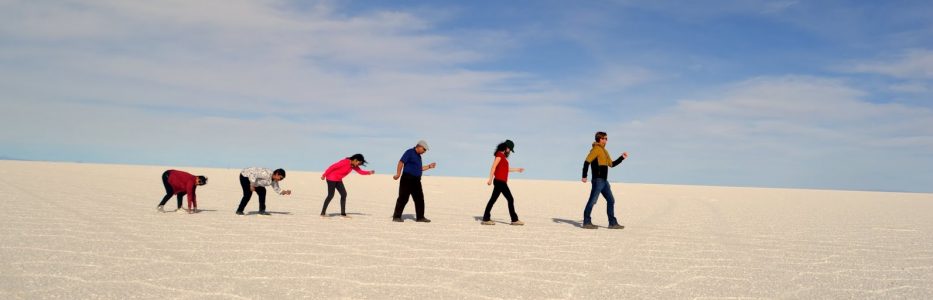

For many Indians, going abroad was always the big, almost unattainable dream, especially during the early sixties and seventies. It signified success in life and created a halo around the person who actually managed to ‘cross the seven seas’. That person was immediately placed on a higher rung in the social ladder. A corollary to this was ‘foreign returned’. There were different kinds of ‘foreign returned’ people. Even here, as everywhere, there was a pecking order.
Persons who studied, worked and settled abroad were the crème de la crème. This lot commanded the most respect, closely followed by the people who studied abroad but decided to return to India to work.
The third variety were the lot who went to foreign countries to visit relatives or as tourists. In spite of their short stay they often sported a pronounced accent and enjoyed many privileges of the ‘Foreign Returned Club.’
Our family also had a good measure of ‘foreign returned’ persons. Their visits to India or return from their foreign jaunts, as the case may be, evoked a lot of interest. Their return followed a set itinerary. The first variety generally brought along a Nikon or a Canon camera and indulged in non-stop photography. The local population was subjected to endless posing for group photographs and candid shots. As a rule, the returnees would bring gifts to be distributed to their less fortunate kith and kin. The gifts were mainly chocolates. A selected few received colourful shirts, chewing gum, Camay soap, cigarette packs such as 555 or Rothmans. In turn, we invited them for a meal or two and the equation would thus be balanced.
A friend of ours used to recall an incident concerning her father’s return from a foreign jaunt. Residing in a small town, her father knew all and sundry and they eagerly looked forward to receiving gifts. Unable to bring such large quantities of gifts due to customs restrictions, this man devised an ingenious method to solve this tricky situation. On arrival, he went to a popular local shop which stocked smuggled foreign goods and ordered Mars chocolates, Parker pens, scarves and other such items, to be gift wrapped and presented. A novel idea indeed.
A relative of ours went a step further in this game. Ratna was very fond of sweets and had indulged in a lot of chocolate eating while touring the US of A. In the process, she had diligently collected all the different wrappers. On her return she proudly showed all the wrappers to her near and dear ones, proclaiming that they were simply the best. The next best thing to eating is seeing, I suppose!
Our neighbour of South Indian Tamil extraction, Tirunelveli Balamurali Krishnan did what so many before him had done. He decided to pursue higher education in the US of A. He returned to Bangalore after a lapse of two years but with a post graduate degree in ‘Applied Mathematics’.
On his return,there were two or three minor but noticeable changes . My mother ‘Lalitamma’ became ‘Ant teee’ pronounced with a distinct nasal twang! I was addressed as ‘Hey Kid!’ and of course he took a ‘baaaa-th’ and would say that it was too ‘hat’ to go outside.
If rumours were to be believed, ‘Krish’ had started eating his South Indian fare with a fork and knife.
Even as a child Meena had set her eyes on the US of A. Her life goal was to emigrate to the promised land at any cost. Due to many unforeseen reasons her dream was a long time coming. During her interminably long wait, she decided to do the next best thing. She worked hard and developed an American accent. Her imitation was flawless and her speech was truly American- she had become a non-Yankee Yank. She finally managed to reach the shores of ‘Uncle Sam’ where needless to say, she fit right in!
These foreign returned types were always on a tight schedule whilst on holiday. Due to shortage of time they were not in a position to catch up with every Ramu, Madhu and Meena. Instead they hosted a potluck party and invited all their close friends and relatives. My mother used to spend hours preparing her allotted dish and would reach the party scene tired and drained after a long innings in the galley. Being a very good cook she used to be given the most difficult dish to prepare. Some got away with the ubiquitous chips and other such sundry items.
Like all teenagers I used to be permanently hungry and was always on the lookout for stuff to fill my stomach. I clearly remember attending a pot luck organized by one of our relatives in honour of their dear son’s visit to Bangalore. All the guests arrived with their share of the potluck and deposited them on the dining table. It was a truly appetizing sight. So many different dishes prepared with love and affection by different cooks and waiting to be devoured. I, for one, could not take my eyes off of it.
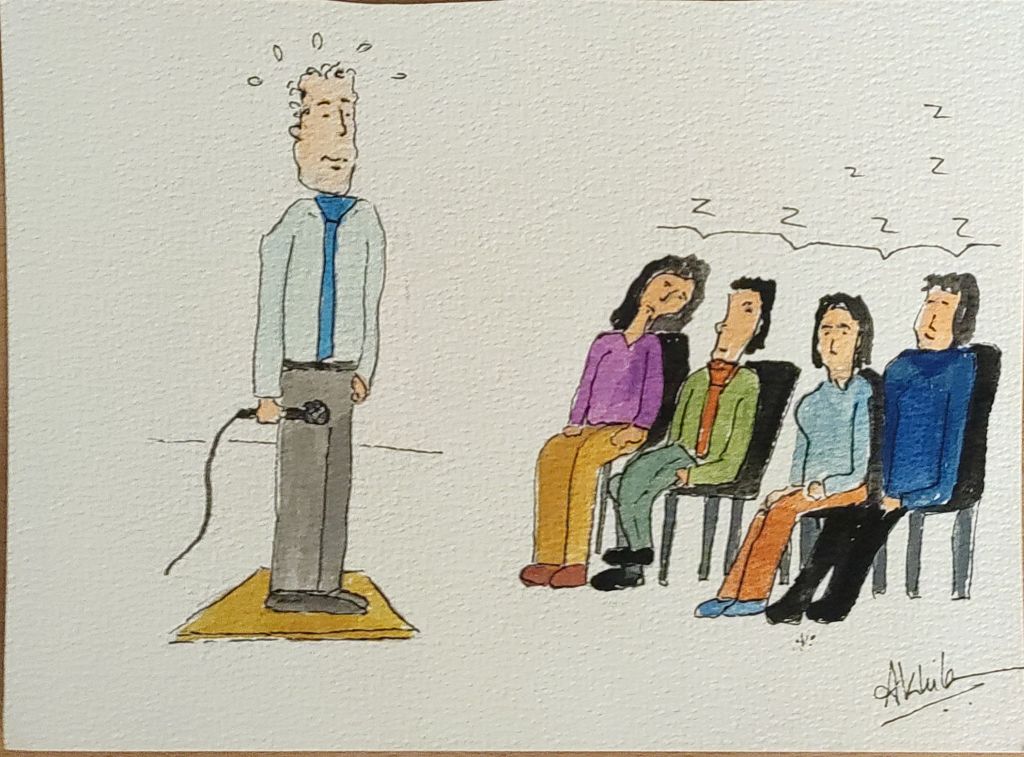
TRUE STATE OF THE GUESTS
However, events did not unfold as expected. The chief host made an announcement requesting all those present to regroup in the next room to watch a ‘Slide Show’. The next hour was spent in watching various aspects of my foreign-returned relative’s life in the US of A. Photos included his apartment, his bedroom, bathroom, his neighbour’s dog, all his college friends, his college, a random nearby park and much more of the same. The relative explained in excruciating detail, the significance of each photo, with great enthusiasm while the rest sat waiting for his monologue to come to an end so that they could attack the food.
As if this boring and torturous experience was not enough, ’Curious Krishna’ would repeatedly interrupt him, seeking clarifications and additional information. We’ve all met such guys who know exactly how to prolong the agony for everyone else! This whole episode was extremely frustrating especially on an empty stomach.
As a cadet in August 1968, I sailed on board the Indian Naval Ship Krishna to Kenya, Tanzania, Madagascar and Seychelles. This was a part of our sea training. Not to be left out in the who-has-gone-abroad race, my father proclaimed to all his kith and kin, that his son was on a ‘diplomatic mission’ to foster international friendship and goodwill.
Finally I had also joined the ‘Foreign Returned’ club.
Things are different today. There are 35.4 million Non-Resident Indians (NRIs) and Persons of Indian Origin (PIO) living outside of India. The Indian diaspora is the largest in the world, with people living in many countries. Foreign travel has become very easy. Hordes of Indians travel all over the world as tourists. There were 27 Million Indians who travelled abroad last year alone, as tourists.
Much to the dismay of old timers, potluck has taken a back seat. FB, X and other social media platforms have taken over as the favourite medium to inform the public about their “foreign returned” status. Anyway, unless your trip has been to Antarctica or Timbuctoo, no one’s really interested.
Cheers until you return from your next exotic foreign trip!

 Captain's Corner