We Visited Wellington 23 and 24 Apr 2016 and ANZAC Day 25 Apr 2016.


Hollywood style
Napier to Wellington is a long drive covering 315 Km, but the scenic beauty of the surroundings makes up for all the fatigue one may experience. We stopped enroute for a cup of coffee at a small village – ‘Woodville’. Starting at 9 AM we reached Wellington around 1 PM and checked into Trinity Hotel in the centre of town. 
 

Along the drive to Wellington

Absolutely fascinating landscape

In 1865, Wellington became the capital city in place of Auckland. Wellington is at the South-Western tip of the North Island on Cook Strait, separating the North and South Islands.
 

A technical halt at a small town – Woodville with a population of 1400

ANZAC Day programme at Woodville

With the owner posing in front of the main street 1890 photograph

A very interesting notice

Distances to various parts of the world from Woodville

Which one is the real pumpkin. At the restaurant

After a quick functional lunch in a food court opposite our hotel, we strolled across to visit the famous Wellington Botanic Garden established in 1868. We hitched a ride to the park on the ‘Wellington Cable Car’. As the car climbs up one gets to see the entire city from a height. The garden spread over 26 hectares of hilly terrain, offers unsurpassed views, unique landscape, exotic forests, native bush, colourful floral displays and well maintained specialist gardens.
 

City Centre

Naveen posing with a mannequin

Inside of the cable car

A view of the city from the garden

Jai all smiles

A different view of the city

View of Island bay

The flora and fauna in the garden

Another part of of the garden

The water front

Enjoying the evening

Later in the evening we went across to the water front restaurant for a quiet drink and dinner. The weather was extremely chilly, preventing us from sitting outside.
The next morning we took the Hop on Hop off to go around Wellington. There were very few people and the driver cum guide made the trip very interesting with lots of information and tidbits. We visited Old St Paul’s Church, Mount Victoria, Maori culture at the Te Papa Tongarewa – a premier museum, saw the special effects behind The Lord of the Rings trilogy at Weta Cave and Museum of Wellington City. The entire HoHo tour was very interesting and informative. 
 

All over NZ there are ‘Information Centers – I SITE. They are of immense help to the tourists.

View of the harbour

View from Mt Victoria

Fascinating views

The sea sky foliage and the cloud made our day

Special effects at Weta Cave and Museum of Wellington City

Gollum – The ring-obsessed hobbit-turned-monster
Guess who is more handsome
Time for a photo op

St Pauls Church

Wellington is undoubtedly a very pretty city.
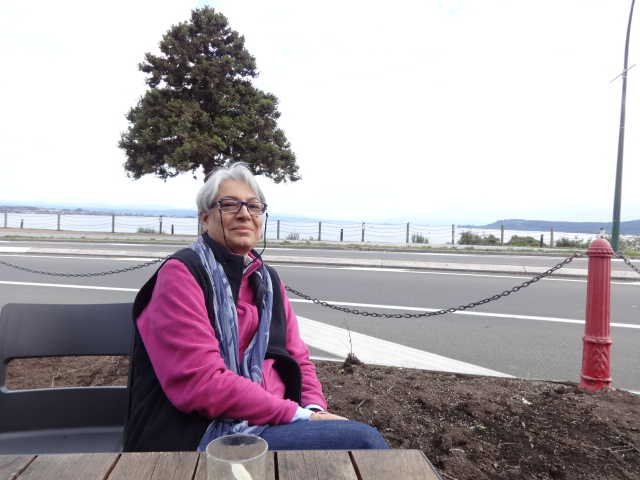
We later went back to the water front to laze in the warm afternoon sun at Mac’s Brewbar at Shed 22 – one of the most popular breweries in the city. This time around we sat outside and took in a whole lot of Wellington. Given a chance I could have spent hours on end sipping beer and gazing at the sea. The bar offers the finest of kiwi beers and excellent food. The place is vibrant and teeming with people. They claim that the bar is a meeting place of great minds and well-honed palates. They offer 8 types of beer – we selected ‘Mac’s Gold’.
 

The Mac Brewbar

Lovely Bar


A great notice in the loo.

After a short nap in the hotel, we went across to an Indian restaurant next door to have dinner.
An aside
The reverence and veneration with which veterans are remembered is worth a special mention. Every town and city we visited was preparing for the big event –“ANZAC DAY’ celebrations scheduled all over NZ on 25 April 2016. It commemorates the landing of the Australian and New Zealand Army Corps (ANZAC) at Gallipoli, Turkey, during World War I in 1915. Among the dead were 2779 New Zealanders. The Anzac Day ceremony of 25 April is rich in tradition and ritual. A dawn service is held in a church in all towns and attended by serving and retired military personnel. Thereafter the ANZAC Day parade starts with the veterans joined by other community groups, including members of the armed forces, the Red Cross, cadets. After the march past they enjoy a tot of rum and coffee.
The events of the Second World War made Anzac Day a time of commemoration of all the wars in which New Zealanders had taken part. Anzac Day is a national day of commemoration observed on 25 April each year. It commemorates those who died serving New Zealand during war while honoring returned and current servicemen and women, past and present. The meaning of the day has been further broadened to include those killed in all the military operations in which the countries have been involved.
Having witnessed the fervor with which the veterans are remembered and respected in New Zealand, Kat and I, both being war veterans, felt a tad disappointed at the way veterans are treated in India.
The Tragic Irony
In contrast, a Bangalore based ‘Residents Welfare Association ‘took out a PIL. They wanted the HC to restrain the concerned authorities from constructing a National Military Memorial, at the Indira Gandhi Musical Fountain Park. It contended that the memorial would alter the landscape of the park, since trees would have to be felled.
Bench of justices, dismissed the PIL saying a National War Memorial was a laudable initiative, since it would instill patriotism in the hearts of the country’s citizens. The court said that the proposed war memorial would not only make people curious to know what it contained, but also inspire the people of Karnataka to work for the betterment of the country.
A new war memorial was inaugurated in Bangalore on 10 Feb 2009.
Mera Bharat Mahan.

We Visited the Waitomo Glow Worm Cave, Lake Taupo and Napier – 22May 2016

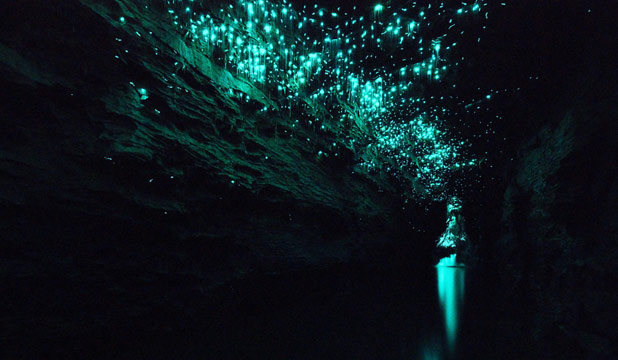
The Glow Worm Cave


The drive from Rotorua to the famous Waitomo Glow Worm Caves took us around 2h, traveling 150 Km through some wonderful terrain. In spite of having to travel long distances we were determined to visit the famous Cave.
We lost our way in spite of GPS – Ha Ha

The rolling hills
A lovely drive

Never ending meadows
The glow worm, Arachnocampa luminosa, is unique to New Zealand. Thousands of these tiny creatures radiate their unmistakable luminescent light nestled in the stalactites, stalagmites and other cave formations. Water which drops from fissures in the ceiling leave behind limestone deposits. The stalagmites form upward from the floor while the stalactites form from the ceiling downwards. When these formations connect they are called pillars or columns and if they twist around each other they are called helciti. These cave decorations take millions of years to form given that the average stalactite grows one cubic centimeter every 100 years.
The cave entrance

The entrance to the cave

As we are coming out
The trip begins with a detailed explanation of the caves, formations and the worms. Then we are taken around the cave in a boat and transported into a very different kind of experience. The glow worms create an alien atmosphere. The boat takes you through this surreal and dreamlike world in total darkness and pin drop silence. Photography is not allowed as light and sound harm the growth of worms. After 45 m of this unforgettable experience we emerge from yet another opening to the world outside.
End of a memorable experience
We then departed for Lake Taupo located 150 Km from the caves. It lies in the caldera of the Taupo Volcano, with a surface area of 616 square kilometers; it is the largest lake by surface area in NZ. Lake Taupo has a perimeter of approximately 193 kilometers and its deepest point is 186 meters. It is drained by the Waikato River.
We spent a couple of hours relaxing in a lake side restaurant, sipping beer and enjoying fish and chips.
View of the lake

Trying to capture the lake

Weather plays a very important role

Effect of lovely NZ beer

Content with life

Adventure sports

Jai all pleased

Naveens turn to be happy
Never ending lake

Spanish Sun Downer Motel

View from the room

Outdoor View

We had to drive another 140 km through dense hilly forests before coming down to Napier. Napier’s major tourist attraction is its architecture, which draws Art De

co and architecture enthusiasts from around the world.

Tiredness written all over

After an extremely tiring day we checked into a very cute motel – Sundowner Spanish Motel – an extremely apt name for  tired souls. In all we had driven 450Km.

The 1931 Hawke’s Bay earthquake, also known as the Napier earthquake, occurred in NZ at 10:47 am on 3 February, killing 256 people and devastating the Hawke’s Bay region. It remains New Zealand’s deadliest natural disaster. Centered 15 km north of Napier, it lasted for two and a half minutes and measured a magnitude of 7.8.

One of our guides told us that NZ experiences a staggering 20,000 minor earthquakes every year. As a result, New Zealand has very stringent building regulations.

Incidentally, when we were planning this trip, Christchurch suffered an earthquake on 14 February.
On 11 May 2016, the last earthquake measuring 4.8 magnitude, took place 6 km from Masterton, Wellington NZ.

We Visited Rotorua on 20 and 21 May 2016


One thing good about New Zealand is they have maintained Maori names for their cities, rivers, lakes, volcanoes and other things in a very big way. Rotorua from Maori: Te Rotorua-nui-a-Kahumatamomoe, “The second great lake of Kahumatamomoe”) is a city on the southern shores of Lake Rotorua, in the Bay of Plenty region of NZ’s North Island. Rotorua has an estimated permanent population of 56,800, making it the country’s 10th largest city. 
Rotorua is a major destination for both domestic and international tourists; the tourism industry is by far the largest industry in the district. It is known for its geothermal activity, and features geysers and hot mud pools. Plenty of lakes and rich forests flourish in the area. The pungent smell of sulfur from the geothermal valley engulfs the entire town. The moment one gets down from the car the smell becomes evident.

More importantly there is a large population of Maoris in Rotorua. They have lived here ever since, taking full advantage of the geothermal activity in the valley for heating and cooking.


A Maori warrior

Another interesting aspect of their culture is the process of naming. The names were chosen to describe landscape features, or to celebrate stories, people and events. Often places were named after ancestors or body parts, to emphasize tribal or personal claims to land.
“Taumatawhakatangihangakoauauotamateaturipukakapikimaungahoronukupokaiwhen­uakitanatahu ”   is the Maori name for a hill near Hawkes Bay. This is reputed to be the longest name of any place in the world. It means ‘the place where Tamatea, the man with the big knees, who slid, climbed and swallowed mountains, known as land eater, played his flute to his loved one’.
It took us almost 4 hours to cover the 232 Km from Hahei to Rotorua, with halts in between to freshen up. As expected the landscape is fascinating – meadows all through with various kinds of trees adding to the overall beauty. The villages and small towns enroute are extremely well laid out, neat and clean. Each house looks better than the other. We stayed at the ‘Jet Park Hotel’ in the centre of town. The city itself is green and peaceful with trees and lovely houses. Each bungalow has a well maintained lawn.
 

Lovely Houses

We spent a very interesting afternoon at the ‘Agrodome’, a sheep farm. They demonstrated sheep shearing and dogs shepherding sheep according to the rancher’s directions.  We got to see and feed a variety of Sheep, Deer, Emu and Ostrich. 
 

Brahmin the Bull

Jai feeding a Emu

Jai feeding an Antelope

Kiwi Tree

A stern looking Yak

Early next morning we visited ‘Te Puia’ to explore The World-Famous Pohutu Geyser, Te Whakarewarewa Geothermal Valley and the Kiwi House. The eruptions can be seen from far and the magnitude of the geyser becomes evident as one goes closer. It erupts to a height of 100 ft twenty times a day. A patient wait is really worth it. Next to it is a smaller geyser named ‘Prince of Wales’ erupting to a modest height of 30 ft. Side by side there are a number of boiling mud pots and fissures. The visit offered a very interesting and unique experience.
 

The World-Famous Pohutu Geyser from a distance

At the entrance

Kia Ora – Welcome

Our Maori guide

Naveen in a Maori House

Jais turn to photo op

Mud Baths

Pohutu from close

A break


At the Geothermal Park


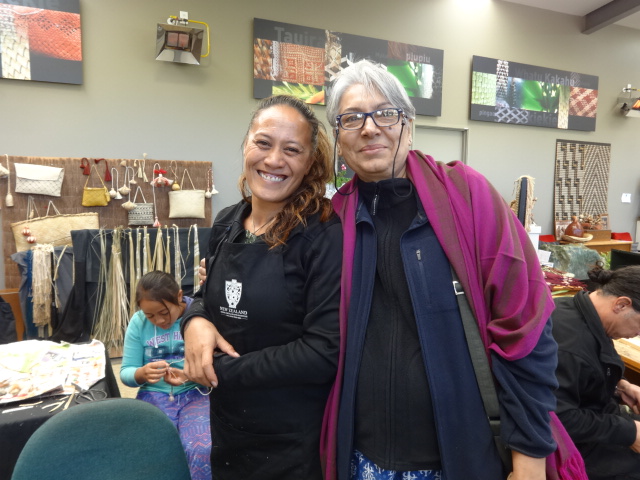
Naveen with a Maori girl
A Maori girl showing flax work

Thereafter we lazed around Lake Rotorua for some time before heading off to Redwoods area to see these mighty trees. Lake Rotorua is the second largest lake in the North Island with a surface area of 80 km sq. Interestingly NZ is a country dotted with innumerable number of lakes.41 major, 229 medium and 3820 small lakes.
 

Lake Rotorua

We were extremely lucky to see 5 out of the 7 most outstanding lakes of NZ. Most of their big lakes are Calderas of extinct volcanoes. A caldera is a large cauldron-like volcanic crater caused by the collapse of an emptied magna chamber, which can extend several tens of kilometers. 
Just five minutes from downtown Rotorua, a beautiful forest awaits you. Known to locals as ‘The Redwoods’, the 5600 hectares ‘Whakarewarewa’ forest is a perfect playground for walkers, hikers, horse riders and mountain bikers with magnificent stands of towering native and exotic trees. The biggest attraction are the Redwood trees – Native to the North West coast of America, given to a Maori chief by a German botanist. The largest Redwood in Whakarewarewa is approximately 72 metres tall and 169 centimetres in diameter. These majestic trees may not have the girth of their cousins the Californian Red Woods, but are pretty impressive themselves. 
 

Jai near the Redwood

A Redwood
A comparison

This was followed by a lovely lunch at an Indian hotel for a change.
We spent the evening in a Maori village “Mitai”. We were treated to a wonderful Maori cultural extravaganza and a delectable dinner with some Maori dishes – stone cooked succulent lamb, chicken, potatoes and much more  We were called ’The tribe of the Four Winds’, meaning four different directions of the world. He said that we (the visitors) were also called ‘sacred feet’ as from the moment our feet touched their sacred land, there was a deep connect between them and us. A beautiful thought. There were 14 different nationalities attending the show. The Maori MC was quite humorous and held our attention as he welcomed each nationality with a few words in their own tongue. 
 

A Maori Village Scene

A Maori couple in a sing and dance sequence

We went and watched the war waging tribals come in their canoe the famous ‘Waka’ – rowing with great fervor and thundering war cry. All the warriors paint their face and body with tattoos to portray a fierce exterior. What followed was a great experience watching Maoris showcase their dance and music from a stage village. Their dances reflect the fierce gestures of the warriors while attacking the enemy and so on. The evening ended with the Chief making a speech about ‘our sacred feet’.
 

A Maori Chief

Tattoos play a very significant role in Maori culture. They have a form of body art, known as moko but more commonly referred to as Maori tattooing. The art form was brought to the Maori from Polynesia and is considered highly sacred. Maori tattoo traditionally does not involve the use of needles; rather the Maori used knives and chisels made from shark teeth, sharpened bone or sharp stones. The inks that were used by Maori were made from all natural products. The focal point of Maori tattooing was generally the face. Only people of rank or status were allowed to have, and could afford to have, tattoos.
Today tattooing is a big time business with many tourists wanting to be tattooed.
The night ended with a bush walk to watch glow worms and a tryst with their holy spring.
The visit to Rotorua was truly a bag full of amazing experiences.

We Visited Hahei – NZ – 18 and 19 Apr 2016

Mercury Bay Hahei


We left Auckland at 9.45 am and made our way to Hahei on the famous Coromandel Coast. We reached our destination at 1215 h – a drive of 175 Km. The drive is extremely captivating taking us through endless mountains and valleys. The surroundings keep you enthralled throughout. Most of the time is spent in photography and viewing. As one rounds ‘Firth of Thames’ the vegetation becomes even more dense and interesting. The drive is extremely lonely with very few cars on road ,no signs of any habitation outside of cities and villages, no human beings to be seen anywhere and definitely no animals.  
The driver should be very alert at all times. To break monotony it’s good to pull over and take a photo break – it helps.
The landscape
We checked into  “Hahei Holiday Resort”. It is a very well appointed resort – extremely clean and comfortable. The facilities include a barbecue pit, free laundry, fully equipped kitchenette and a small restaurant. The cottage we stayed in was extremely well equipped – down to a can opener and corkscrew! It had wooden floors and a verandah to die for! The place is huge and accommodates camper vans and tents. One can walk across to Hahei beach behind the resort.
Naveen at the entrance to the resort
Jai absorbing Hahei

Hahei is derived from the Māori name for Mercury Bay, Te-Whanganui-A-Hei, or “The Great Bay of Hei”. Its resident population is around 300 and it is home to the world famous ‘Cathedral Cove’ and a hot water beach. The village itself is very small with one all purpose store, a single petrol bunk, a few restaurants and resorts for tourists. Two of us wanted to stay a little longer in Hahei than planned while the other two wanted to come back and settle down for good. That was the impact of this cute little village.
The Gang

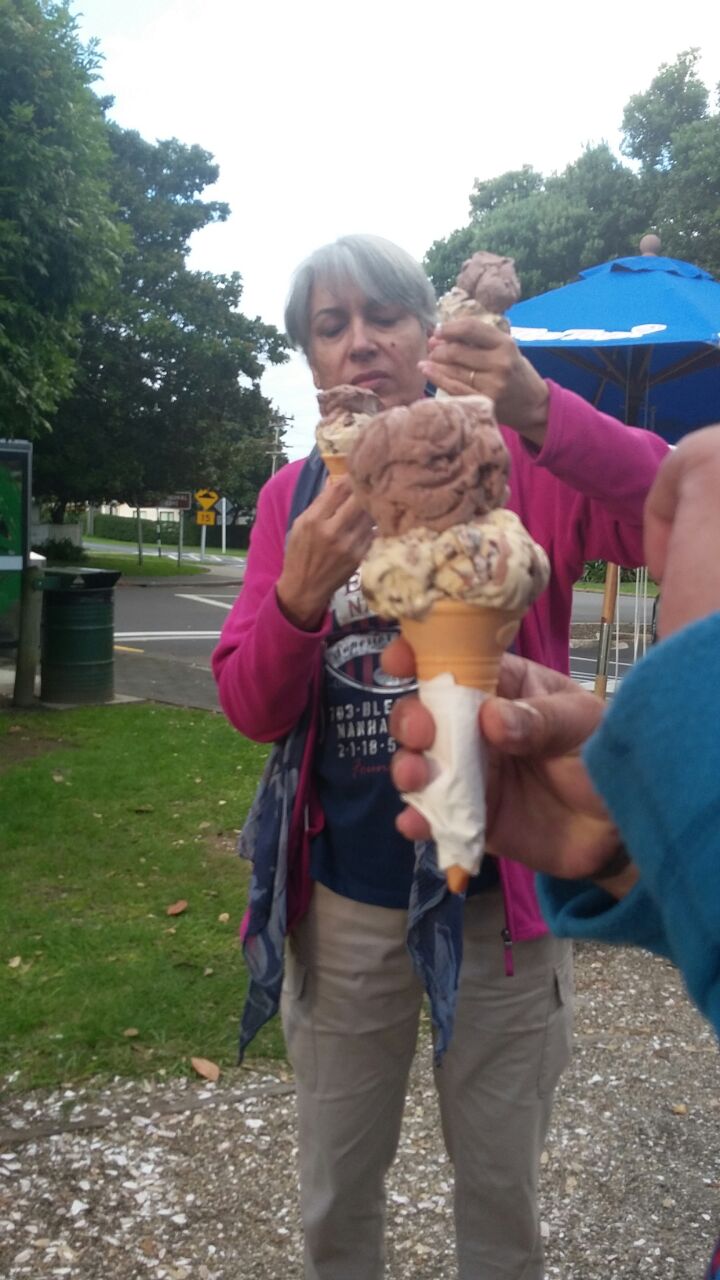
Starting with Hahei we took a special liking to Kiwi ice cream in a very big way. Their ice cream is quite rich and creamy. The helpings are awesome and the flavors are mind blowing.

Some Ice Cream Cone
The store keeper was very helpful and went out of her way to book us for a speed boat ride to visit the coves.
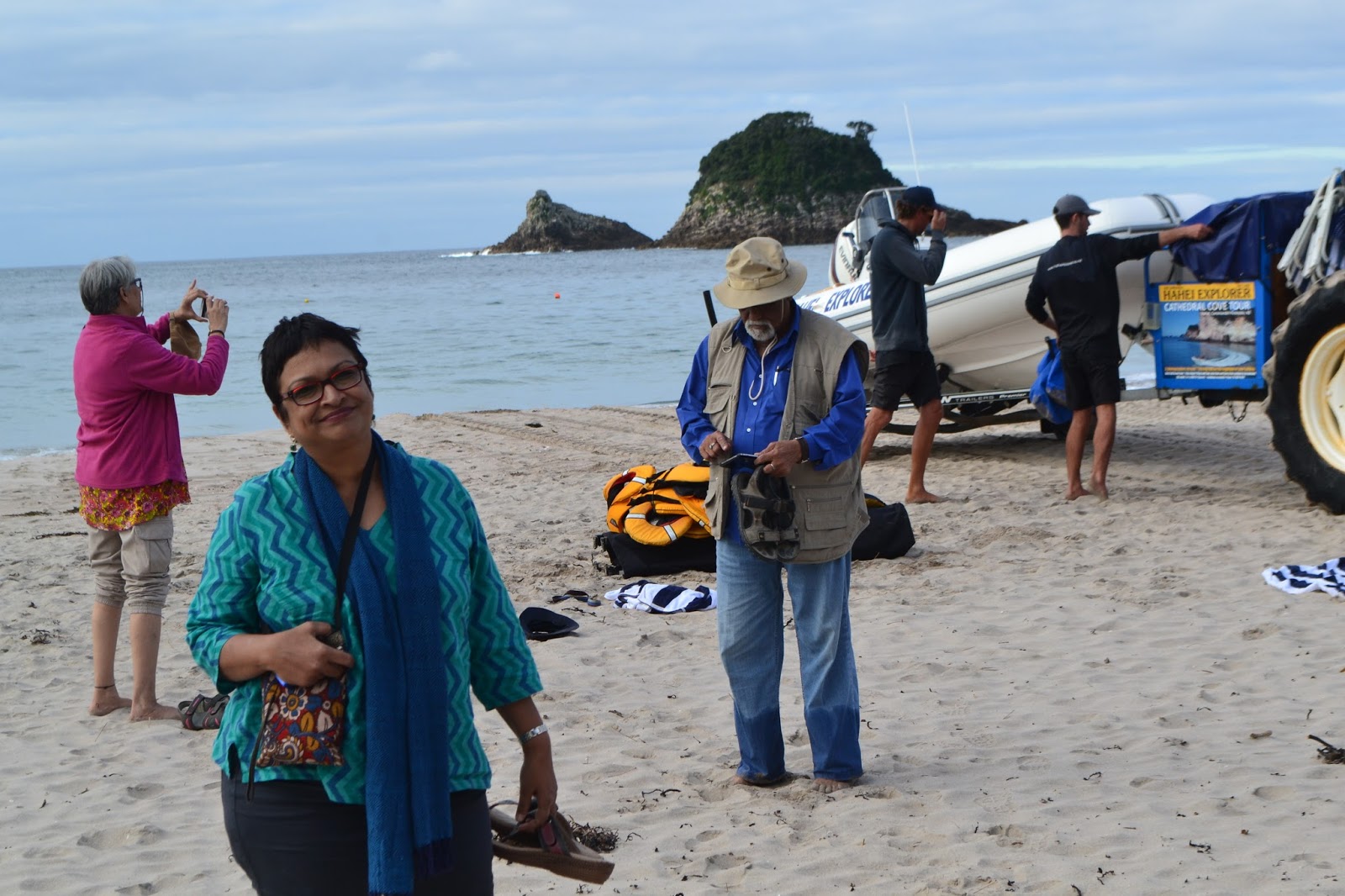
Getting ready for the ride
The Coxswain and the guide told us that Captain Cook landed on the beach that now takes his name in November 1769, to watch Mercury (hence the Bay’s name) cross the sun. After some astronomical calculations Cook worked out the latitude and longitude, putting New Zealand on a map.
A distant island

 We went on a speed boat ‘Hahei Explorer’ to watch the coves and the volcanic coastline. The one hour tour covers the entire coastline giving us an opportunity to take a close look at all the coves, enter some of them and watch the volcanic formations which dot the entire sea area. This unique combination of sea, sand, rocks and trees makes the coastline extremely attractive and romantic.

Fascinating Rock Formations

From inside the cove a novel experience

All dressed up

One of the coves leads into a fascinating cave- when you look up you can see a tiny bit of the sky surrounded by a magical circle of trees looking down on us. The coxswain of the boat told us that the Maoris used to come to this cove to find peace, quiet and calm.

A very unique cove

At the bottom of the cove

Entrance to deep cove

Imposing volcanic rocks as the lava flowed

Yet another deep and narrow cove

Mares Leg Cove,

Sea,Sky,Rock and Trees – simply fascinating

Finally the Cathedral Cove
No wonder people from all over the world come to Hahei to unwind and enjoy – it offers unlimited outdoor activities such as kayaking, scuba diving, surfing, trekking and living in the wild. We ended the day with a glass of chilled beer and a delectable lunch. 
Hahei resort observes ‘Quiet Time’ between 10.30 PM to 7.30 AM during which time there should be no noise and no music.
The next morning was spent lazing around the ’Hot Water Beach’. Some volcanoes develop huge underground reservoirs of super heated water. Over time, this water escapes to the surface — cooling on the way. There are two fissures at Hot Water Beach issuing water as hot as 64ºC (147ºF) at a rate as high as 15 liters/minute. This water contains large amounts of salt, calcium, magnesium, potassium, fluorine, bromine and silica. The hot spring starts one hour before the low tide and lasts one hour after the change. We reached the beach at 1000 h sharp as the low tide for the day was at 1100h.
A tiny bubble of hot water escaping from the sand
Jai with a shovel all set

The whole exercise was to dig a pool sufficiently large to accommodate the four of us to lie down in the sand where the hot water wells up. The hot water is to be found only at two spot on the beach. Everyone heads for it an hour before low tide. The hot water from the spring mixes with the tidal wave making it hot enough to lie down and laze. One can see the steam rising up from the sand where the water is really hot.   The atmosphere on the beach immediately transforms you into a child. Four of us went into a frenzy to dig a hole for ourselves to bathe in this unique volcanic hot water. The spring water by itself is extremely hot and unbearable to touch. One has to be careful to avoid getting the soles of the feet burnt. As the tide rises, the cold waves of the sea engulf the area so one can only sit for those two hours or so.

Naveen refused to leave the pool and continued to remain in the spa for two hours.

The Hot Water Beach scene

Jai, kats and Naveen enjoying the spa

Naveen refusing to get up

One last attempt
Totally pleased !!!!
It was indeed a novel experience.
Totally agree with the notice
Very reluctantly we departed from Hahei next morning, carrying with us loads of wonderful memories of this charming little seaside village.

We Visited New Zealand from 15 Apr to 06 May


Iconic Sky Tower Auckland

Somehow, New Zealand does not automatically come to one’s mind when planning a holiday abroad. The general impression is – It is very far, tucked away somewhere close to Antarctica, Kiwi is their national bird, all of us have used Kiwi shoe polish and they play cricket. While talking to friends who travel a lot, New Zealand emerged as a very promising tourist destination with breathtaking countryside, pristine lakes, snowy mountains, geysers, beaches, virgin forests and an opportunity for extreme adventure. 
New Zealand was first settled by Eastern Polynesians between 1250 and 1300. Over the centuries that followed, these settlers developed a distinct culture now known as Māori. The first Europeans known to have reached New Zealand were Dutch explorer Able Tasman and his crew in 1642. Europeans did not revisit New Zealand until 1769 when British explorer James Cook mapped almost the entire coastline. Exactly 247 years later Self, Jai, Kats and Naveen landed in Auckland on 15 Apr 2016.
Having been in the travel game for a very long time, we did the entire research and planning on the internet. I can definitely go on record to say it cost us only half as much as any reputed travel agency. The exploration on the net is really fascinating – getting to know the country, people, culture and much more. Planning your own trip gives a tremendous amount of involvement and satisfaction.
To get a better perspective of the size of NZ – It is smaller than Maharashtra. With a population of 4.6 m, this is half of Bangalore’s 8.42m.
Australians account for the maximum number of tourists visiting NZ. What stands out is the large presence of Chinese and Japanese. 46,000 Indians visited NZ in 2015
Popular tourist activities in New Zealand include sightseeing, extreme adventure sports, nature tourism, hiking and camping. New Zealand is marketed abroad as a “clean and green” adventure playground.
Auckland – 15 to 18 Apr
We opted to fly by Malaysian Airways, as the cost and connections were good. ‘Bangalore to hotel in Auckland’, including immigration, transit halts and the actual flight is almost 24 h and extremely tiring. We were really worried about the immigration process concerning food, medicines etc. We went through without any problem. We checked into Auckland Airport Kiwi hotel and crashed.
 

Jai in front of Kiwi hotel

First thing in the morning we went out and hired a Toyota Corolla for our internal travel. Hiring a car is extremely easy. An Indian driving license, readable in English, is sufficient. One must be very conversant with NZ traffic rules, signage and other regulations. 100Km/Hr is the driving speed throughout the country.NZ has extremely well laid out roadways, running from North to South. Like India, it is also a left hand drive. Driving is effortless and tension free, as there is no traffic at all. In my opinion there is no other way of doing NZ than by car.
Auckland in the North Island is the largest and most populous urban area in New Zealand. Auckland has a population of 1.4 m which makes up 32 percent of New Zealand’s population of 4.6m.The city is bustling with people like any other metropolis. The Central Business District is a shade dirtier than its European counterparts like Prague or for that matter Cape Town in SA. 
 

Jai Naveen and Kats on the run Auckland CBD
CBD Auckland

It is better to use local transport within the city as parking is a major issue inside the CBD. Taxis are reasonable. We decided to use the Hop on Hop off bus to tour the city and it turned out to be very convenient. HOHO picks you up from the hotel and drops you off at the end of the day.
The first afternoon we visited Waiheke Island which is known for its beautiful vineyards, olive groves and beaches, just a 35-minute ferry ride from downtown Auckland. We had an excellent lunch by the sea. Their helpings are large and generally sufficient for two. Kats and I used to share non veg meals, similarly Naveen and Jai being vegetarians. NZ has no particular cuisine of their own – Continental, Indian, Chinese and Japanese restaurants dot the entire eating scene. A good lunch with beer and wine for four costs around 110 NZD, ie about INR 5000. 
On the ferry
Auckland from the ferry
Another view of the city from the ferry
Waiheke Island
Jai having lunch at Sand Shack Waiheke Island


View from the restaurant

There are a large number of Indians in Auckland, most of whom work in the service sector in hotels and restaurants.
The next day was spent on the HOHO going around the city.  The township itself is very well laid out and very tidy. The town boasts of many parks and gardens. We drove around the picturesque Mt Eden, a suburb of Auckland which boasts of houses built during the late eighteen hundred and extremely well preserved. Most of these houses are built from the trunk of the Kauri tree, one of the world’s mightiest trees, growing to over 50 m tall, with trunk girths up to 16 m, and living for over 2,000 years. The guide told us that 15 houses can be built from one tree trunk. In contrast, it is sad to see all the old, beautiful bungalows giving way to glass and steel high rises in the city of Bengaluru. Preserving heritage buildings in a city is what gives the city its character and ethos.
A bungalow in Mt Eden
Each one is better than the other
Suburb of Auckland

We got to see a kiwi in Auckland Zoo. The Kiwi enclosure is totally dark as they come out only at night to feed. 
We visited the ‘Auckland War Memorial Museum’- a very dignified and imposing structure is situated on top of a hill. The building is considered one of the finest Greco-Roman buildings in the Southern Hemisphere- a must see item. In the natural history section, there is an enclosure for children named ‘Look Touch and Explore’ which is very unique and interesting. 
 

An Imposing Structure


In the museum in front of a Maori House
Te Toki-a-Tāpiri is one of the last of the traditional waka taua (war canoes) remaining from the 1800s. It is 25 metres long and carried up to 100 people. It was built around 1836. It is now on display in the Auckland War Memorial Museum.

The weather is extremely unpredictable – a lady in the restaurant remarked that Auckland often experiences all four seasons in a single day! We visited the iconic ‘Sky Tower’ which offers a panoramic view of Auckland from 220 m – 722 ft height. We had a nice lunch and for the more adventurous types there is a Sky Jump and Sky walk from the tower.
 

Finally – At the Sky Tower
Sky Jumper caught on camera
View of the city from 722 ft

Our HOHO driver was a Maori gentleman. During the short interaction I had with him, I learnt that the Maori have by and large integrated well with the European settlers. Unlike the aborigines of Australia the Maoris have integrated into the modern social fabric of NZ reasonably well. The current governor-general is Lieutenant General Sir Jerry Mateparae, a Maori. At times they are considered second class citizens. Maoris used to have extremely large families. The driver was one of 11 siblings and his father was 1 of 18. This trend is tapering down and they now have 3 to 4 children. 36,000 NZD/year is required to lead a decent life in NZ. All Maoris have embraced Christianity and some continue to observe old traditions and Maori religion alongside. A lot of Kiwis go to work in Australia as they get 30% more wages. Kiwis and Indians are ranked as extremely hard working people. Maori are the backbone of the labor community of NZ. The driver was not happy with the government dolling out social security – it has made many Maoris lazy and induced them to booze and take drugs. We did come across a group of high spirited Maoris in the city, having a whale of a time.
 

HOHO Maori driver

If one is not a club member in Auckland, it costs 400 NZD (INR 18,500) for playing 18 holes golf, which includes green fees, caddy, golf set and the cart.
One or at the most two days is more than sufficient for seeing Auckland.

Goodbye 2015, Wishing all readers of my blog a happy 2016.Nagarahole,Navy Day, Killers Night, Night at the Museum, Deepavali, Barbeque on 24th night, Masnagudi and other stories.


Figure 1 – The Prabhakar clan – 31 Dec / 01 Jan 2016. Hugo the Lab joined us in Feb 2015
At the very outset I wish to thank all readers of my blog for continuing to visit ‘samundarbaba’. I take as much pride in writing for the blogs as you enjoy reading them. It is a matter of great satisfaction to know that ‘samundarbaba’ is read across 86 different countries.
2015- It was a very good year; I don’t mind joining Frank Sinatra in singing the song – provided the family permits. As usual we travelled a lot during the year. We visited Turkey, Czech Republic, Poland, Romania, Croatia and Slovenia. It was a very interesting journey through these countries. Fortunately we visited them well before the refugee problem erupted. These countries have a lot to offer tourists. We went with very close friends and this makes an incredible difference. The trip becomes even more enjoyable when one travels with likeminded people. This year our internal travel was limited as we had to cancel Kaziranga at the last minute; instead we went to Cambodia and Vietnam. These countries offer a totally different experience. I have documented these trips in some detail in my blog – samundarbaba.blogspot.in
Among other things traveling, golf, grand parenting and cooking remain my most cherished activities in retirement.
2015 was a very special year for our children, Vivek and Shubhra. Chumbak added apparel to its portfolio by launching a fashion apparel line branded “Collection One” for men and women. It has been a remarkable success. They also plan to open 50 new retail outlets by the end of this year.
More than all this ‘Hugo’ the Lab joined Samara in Feb 2015 and has been the centre of attraction ever since then. Bow wow.
Figure 2 – Founders of Chumbak
Akhila and Anirban took time off from their busy schedule and went around Mumbai selecting a house to buy. Finally they decided to settle down in Pali Hill and moved into their own house during Deepavali. We went across to Mumbai to be with them for a very lovely house warming party. Anirban continues to be busy with CAAKWAN. Akhila was busy discovering new talents and interests within her. 

Figure 3 – A view of the new house from the drawing room
The grand children are growing up fast.Their need for the grandparents is slowly decreasing as they grow up. They have become very independent. Books have entered into the life of Ayaan and Samara in a very big way. Both have devoured the Harry Potter series and other books during the year. The twins are fun to watch and find great company in each other. But at night, before sleeping all of them without exception, come to Tata to listen to stories.
On the whole they had a whale of a time during the Christmas holidays in Bangalore and so did we.
Jayanti was busy throughout the year with the school. Freedom International School started 11th and 12thstandard classes from this year. FIS completed 10 years this year.The school continues to grow in academics, sports and other extracurricular activities. This year’s piece de resistance was  undoubtedly their annual day play “Night at the Museum’. The play was loosely structured on the film by the same name directed by Shawn Levy and starring Ben Stiller and the late Robin Williams. 
The play was staged on two successive days and all the 1300 children of the school participated. The stage, lighting and acoustics were breathtaking and added to the overall effect. The children contributed their histrionic might, making it an incredibly memorable event. The audience sat captivated as history unfolded on the stage – from stone age to Nelson Mandela passing through Alexander the great and Porus, Abe Lincon, Mahatma Gandhi, 2nd World War, Moon Landing etc. Daughter dear wrote the script and made her directorial debut with a play of this magnitude for the very first time and emerged extremely successful. Many accolades went her way. The director of the school Mrs Sushama Rajesh Rao provided the all essential impetus and overall management.

Figure 4    A scene from ‘Stone Age’ period

Figure 5 – Julius Caesar holding court – Roman Empire
Figure 6Alexander the Great fighting Porus
Figure 7  A paper mache creation of ‘T Rex’ made by the drivers of FIS – remarkable endevour.
Figure 8Mrs Sushama Rajesh Rao, Director of FIS appreciating Akhila’s effort as Jai is all smiles.

Figure 9  A very unique X – Mass tree displayed at Freedom International School
The Marine Commandos from Mumbai visited us in June for their summer vacation. The local GI Jane joined them in right earnest. Visits to Bannerghatta National Park, the Planetarium, a trip to Nagarahole and other local activities kept them well occupied. As they grow older, a detailed plan needs to be put in place to occupy their free time.
Figure 10Two Leopards sun bathing on a rock. Bannerghatta National Park

Figure 11Two sloth Bears fight on the road. Bannerghatta National Park

Figure 12Can’t get any closer. Bannerghatta National Park
Akhila organized a wonderful birthday party for the twins on 02 July. 

Figure 13All the children at the twins’ birthday party.

Figure 14Cake of their choice – Agastya and Aarin. Wild Kratts on the Left and Chris and Martin on the right.
All of us went to Sushama’s yet to be officially inaugurated wild life resort ‘Wilderness Retreat’ near Nagarahole.  It was a great experience for all of us – the children loved being in the midst of nature, sleeping in tented accommodation, safaris, feeding goats, bonfire and a whole lot of wilderness all around. They could not have asked for anything more. It was a lovely holiday. Thanks, Sushama. 

Figure 15At the entrance – under construction

Figure 16Akhila in front of a deluxe cottage

Figure 17Samara with the goat, as Anees and Akhila look on.

Figure 18Akhila and Sushama with the children on top of the viewing platform.

Figure 19An elephant encounter on the way. This one is known to be troublesome.

Figure 20A group of deer

Figure 21 – Jai, Sushama and Akhila all pleased

Figure 22Cottages hidden in the rich flora and fauna
 
Figure 23Bye bye ‘Wilderness Retreat’
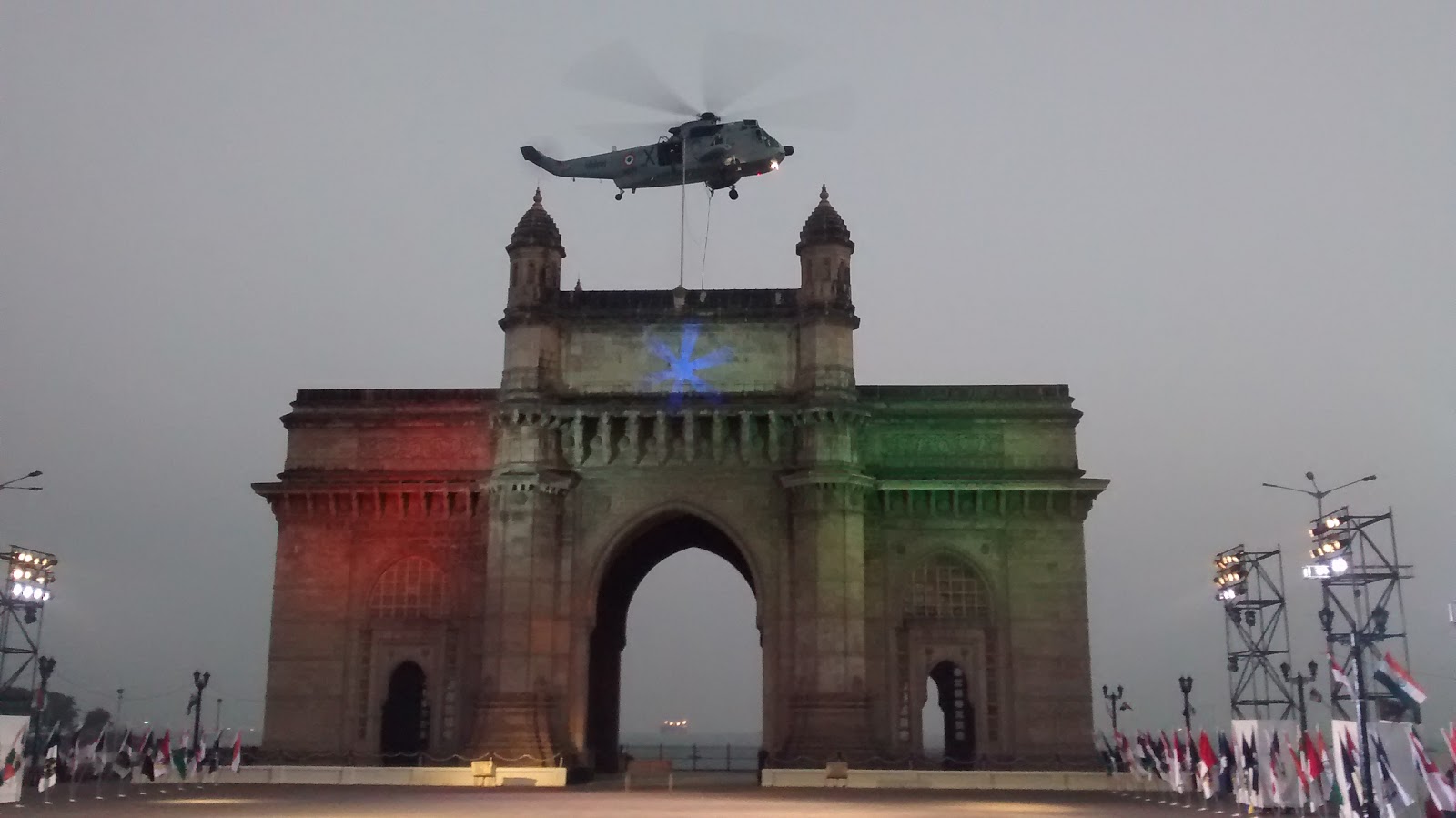
This year I decided to attend the ‘Navy Day’ celebrations in Mumbai on 04 Dec. This day has a special meaning for all of us; especially to those who served in the ‘Killer Squadron’ which attacked maritime assets off Karachi on the night of 04 Dec 1971.I was a young ‘Killer’ on board INS Nashak as a Missile Officer during this historic occasion. After the ‘Beating the Retreat’ ceremony at the Gate Way of India, the Killers met at the USO Club to unwind and slide down the memory lane. Meeting old wartime mates after a long break was a very emotional and heart rending event. Long live the Killers.
Figure 24Naval Band at Gate Way of India as the Governor of Maharashtra watches the show


Figure 25A Seaking helicopter demonstrating commando slithering.

Figure 26The ‘Killers’ from 1971 at USO club, Mumbai
This year’s Christmas barbecue partywas a big hit and the children enjoyed running around, eating chicken and generally keeping the place alive. Unlike previous years there was no carry forward to the next day. Finally I have settled down to cutting the chicken into eight pieces and allowing three pieces per head.
After a hectic night the kids woke up late next morning to be greeted by the gifts Santa had bought for them.
Figure 27Mighty pleased with the gifts.
As a part of our end of the year family outing we decided to visit ‘Jungle Hut’ located in Masnagudi. When going with children, it is very important to select a place which is children friendly. Ideally the resort should be close to a beach or a forest. Children love to spend time in a swimming pool and run around and play outdoors. Located at an altitude of 3000 meters Jungle Hut is an excellent property for a getaway from Bangalore. We left Bangalore at 0630 h to beat the Bangalore chaotic traffic. After a sumptuous breakfast enroute at Kamath’s, we landed at the hut around noon – nothing more invigorating than a glass of chilled beer.
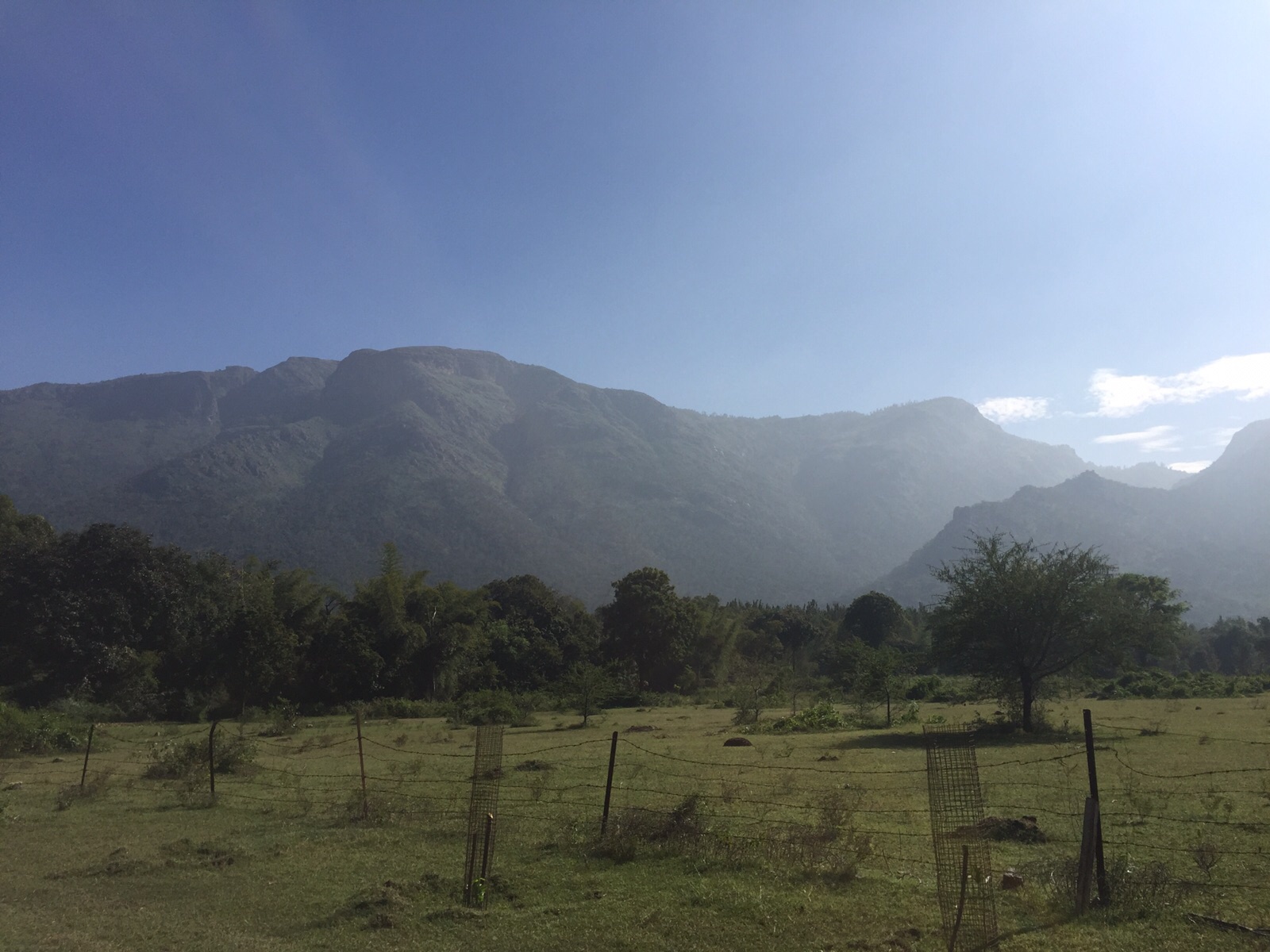
The property is located on a 20 acre area amidst abundant greenery. The majestic Nilgiri hills overlooks the resort providing an enticing backdrop. The open space, salubrious climate and the quiet atmosphere is a great change from the noisy city life. The early morning weather was ideal for walks and treks. The sun picks up and becomes sharp as the day progresses exhorting the adults to seek shelter in the shade for some serious elbow bending, whilst the children splash around in the pool in gay abandon.
All the meals were delectable – the food was extremely tasty and there was a wide variety of dishes to suit everyone’s gastronomical urges. Lot of planning, care and concern appears to have gone into this culinary exercise.  
  
As the sunsets the bon fire is lit and the guests slowly gather around the fire to sit and chat. The crackling of cinder, clicking of glasses, mesmerizing jungle rumblings and occasional sighting of deers make the night all the more enchanting.
However the biggest contribution in making the resort truly remarkable comes from the owners – Vikram and Anu Shree. The V and AS combo, work tirelessly in creating a very cordial and homely atmosphere in the resort. They make it point to mix with guests and chit chat, making the whole ambiance friendly and vibrant.  Their smile and eagerness to help is contagious and goes a long way in creating a good deal of bonhomie.
Figure 28 – The proud owners of Jungle Hut – Anu Shree and Vikram
We stayed in a secluded and independent bungalow some distance from the main resort. We were dropped and picked up for all the meals. We also managed to go on a safari one night as news of a ‘big cat’s’ presence near our resort reached us.
We really enjoyed the outing and promised to return. 

Figure 29 The lovely bungalow we stayed in. 2BHK an ideal place for a family. Right in the middle of nowhere.
 

Figure 30View of the Nilgiris from the bungalow

Figure 31Akhila and Anirban enjoying nature. A lovely place to catch up on reading, long walks, doing nothing just taking in lungs full of fresh air and enjoying the solitude the place offers.

Figure 32Masti masters in the tree house

Figure 33Akki with Agastya all happy

Figure 34Enjoying- simply

Figure 35A typical Jungle Hut cottage

Figure 36Kids in the pool

Figure 37Relaxing after a swim

Figure 38Petting a young calf

Figure 39Collecting firewood on the trek
 
Figure 40Did you enjoy Jungle Hut – their signs and smile says it all
 
Figure 41Shubhra and samara – totally pleased
The year ended with a quiet family evening at home. We all sat around the bon fire remembering the year gone by and ushering in 2016 the New Year. 

Figure 42The bonfire on 31st night

Figure 43Letting go 2015

We Visited Ha Long Bay 23 – 24 Oct 2015, Vietnam


Being in the navy I was able to see many facets of the magnificent sea. Through passage of time I was able to observe and be a part of the nature’s creations- mesmerizing beaches, sea fronts, harbours, islands, lagoons and never ending stretches of different and varying coastline. But, nothing had prepared me to absorb one of nature’s wonders – breathtaking ‘Ha Long Bay’ located in the Gulf of Tonkin which is 165 km from the capital Ha Noi.
Halong Bay features hundreds of limestone karsts and islands. Karsts are gigantic lime stone formations jutting out from the sea in various sizes and shapes. The bay has a 120 km long coastline and is approximately 1,553 square km in size with 1969 islets. Several of the islands are hollow, with enormous caves, while others support floating villages of fishermen.
In 1994, the core zone of Hạ Long Bay was listed by UNESCO as a World Heritage site.
No amount of writing can bring out the beauty of these formations, majestically jutting out from the blue sea into the open sky. The bay along with Sung Sot cave is a rare visual experience one should plan to see in their life time. A long and steep climb takes you into the hallow of the Karsts. The narrow and winding path suddenly breaks into a cave of unimaginable proportions. Call it what you may – nature’s grand theater, art house or museum, it holds one and all in instant captivity. 
From Ha Noi it’s a four hour drive to the bay. En route the tapestry gradually changes from low lying paddy fields to hilly green. On reaching the bay you embark one the many boats for an extremely eventful day and night cruise along the coast. The boats are very well appointed with good cabins and private sit outs to enjoy the view. Variety of Vietnamese cuisine enthralls the guests along with an amazing cooking demonstration. 
The only downside to this tour was paucity of time. This being a package, I found too many activities were rolled together. I would have preferred a slow and evenly spaced unfolding of events giving us more time to sit in the open deck, sip beer and enjoy the nature’s bounties. 
 
If I were to go again I would try to get a customized two nights cruise.
Until then ‘Chill Madi”
Our abode for one night
View of the harbour
A boat cruising along
A lonely island
A group of islands
The extent of the lime formation
Odd shapes and size
Entrance into the cave
Sushuma and Jai after a steep climb
View from the top
A group of boats tied together
 

A local trader
Opening to the cave
Simply enormous
It takes different shapes
Yet another view
See the size of the cave in comparison to the visitor at the rear

The gang
The depth is mind blogging
The idol like formation in the centre attributed to image of ‘Lord Ganapati”
Fish cutlets with carrot decoration
With a Norwegian tourist
With her boy friend
Sushama and Jai Kayaking
Early morning view
Remarkable food decoration demonstration
Anoushka and Sushama enjoying the moment
Private yacht may be next time

We Visited Vietnam 19 to 25 Oct


Vietnam conjures up a number of thoughts and images in one’s mind, foremost being ‘WAR’. No other country on this planet has suffered war longer than Vietnam. 
Before World War II, Vietnam had been part of the French Empire. During the war, the country had been overrun by the Japanese. When the Japanese retreated, the people of Vietnam took the opportunity to establish their own government led by Ho Chi Minh. However, after the end of the war, the Allies gave back South Vietnam to the French while the North was left in the hands of Viet Minh. In October 1946, the French announced their intention of reclaiming the north. The war started in November 1946 and continued till the French pulled out in Nov 1953.
The Vietnam War started as a result of U.S strategy of containment during the Cold War, which aimed at preventing the spread of communism throughout the world. It revolved around the simple belief held by America that communism was threatening to expand all over South-East Asia. The American war against Vietnam started on 1 November 1955 to the fall of Saigon on 30 April 1975.
In comparison, World War II was fought for a duration of 5 years.
All in all, Vietnam was at war for a mind boggling period of 10 years with France and 20 years with Americans. Some estimates place the number of people killed during this period between 2 to 3 million. 
The intense suffering undergone by the people of Vietnam due to war and Cambodia due to war and genocide has no parallel. I believe the loss, grief and suffering cannot be quantified in any fashion.
In comparison, India has been a very safe and secure nation, post independence. Each one of us should be proud of this achievement. We should not only cherish this outcome, but should strive hard to preserve and protect it.   
Ho Chi Minh City 19 Oct
After the war ended in 1976, the city of Saigon and a few other nearby provinces and districts were combined to create Ho Chi Minh City in honor of the late Communist leader. District 1 is the financial and commercial hub of Ho Chi Minh City. Most travellers spend a majority of their time here. District 1 was designed by French architects during the colonial era, which explains the wide, tree-lined boulevards and number of parks. District 1 under the American influence became the most important place in Vietnam. Today it looks and feels like any other modern city – sky scrapers, bustling traffic, chic commercial establishments, malls et al. 
The frontage occupied by any building determines the amount of property tax to be paid. Consequently most of the buildings in Vietnam have a very narrow frontage and grow vertically. Housing is prohibitively costly especially in District 1. 
Our guide told us that at one point of time Saigon was the envy of Bangkok and Singapore. Now, under the communist rule things are different – unemployment is rampant – 90% of the population is involved in petty jobs – selling tea, coffee, lottery tickets and such other things. Having come out of a long war, they say it’s difficult to become rich but it’s easy to live here. They feel even Cambodia has caught up with them and the day is not far when Laos will also catch up. Corruption is believed to be rampant – the method adopted is bottom to top. 
Earlier, the Vietnamese used to marry very young and it was common for couples to have more than ten children. They preferred a son to a daughter. Even in government schools one has to pay for education. Children study up to 14 subjects at school! As a result, the Vietnamese are good at writing but not used to speaking. The capitalist Saigon feels life was better before the communists took over in 1976. 
We were told that one has to be pure Buddhist for three generations to get a government job – an extremely odd requirement in this day and age.
VND or the Vietnamese Dong is their official currency. 1 USD fetches 22,470 VND. By the time we were able convert USD to VND and finally into Indian Rupees the holiday was over. It is better to device your own simple thumb rule to manage currency on a daily basis.
HCMC airport is modern and well maintained. Airport taxis are reasonable and easy to hire. We found our way quite easily to Hotel Anpha Boutique in District 1. The hotel is located right opposite the famous Ben Thanh market.

Figure 1 – Anpha Boutique hotel. Clean, tidy and very functional with an excellent roof top restaurant.
Figure 2– Ben Thanh market is huge, hot and humid. Crowded with people shopping everything from clothing to food, drinks, souvenirs, coffee, tea, handicrafts, bags, snacks, daily necessities etc. It reminded me of Palika Bazaar in New Delhi minus the air conditioned atmosphere. Sushama and Jai shopping.

Figure 3Waiting for lunch to arrive – Anpha Boutique Hotel
Củ Chi Tunnels
After a quick lunch we headed out to see the famous Củ Chi tunnels – pronounced ‘Ku chi’.
In order to combat the better-equipped American and South Vietnamese forces during the Vietnam War, Communist guerrilla troops known as Viet Cong dug scores of tunnels, including an extensive network running underneath the Củ Chi district, Northwest of Saigon. Soldiers used these underground routes to house troops, transport, communications and supplies, lay booby traps and mount surprise attacks, after which they could disappear underground to safety.
As the United States relied heavily on aerial bombing, North Vietnamese and VC troops went underground in order to survive and continue their guerrilla tactics against the much better-equipped enemy. In heavily bombed areas, people spent much of their life underground, and the Củ Chi tunnels grew to house entire underground villages, in effect, with living quarters, kitchens, ordnance factories, hospitals and bomb shelters. The Củ Chi tunnels are 121 Kms long and are now maintained by the government as a War Memorial complex.
The tunnels are a standing testimony to the unmatched resilience, ingenuity and determination of the Vietnamese people.
The guide told us, whereas an undernourished Vietnamese soldier could easily squeeze through the narrow opening of the tunnel, Macdonald fed US soldiers found it impossible to enter these tunnels.

Figure 4 – Tunnel entrance. These 30 by 50 cm holes in the ground led into pitch-black tunnels that were only 0.8 m wide and 1 m tall.

Figure 5 – A Vietnamese guard entering the tunnel

Figure 6 – Another type of entrance – slightly bigger

Figure 7 – Only the fittest could enter. Sushama attempting to enter the tunnel. Brave girl indeed!

Figure 8 – Jai and Anoushka behind clay model Vietnamese sentry

Figure 9 – They built a very elaborate ventilation system underground. These ant hill like structures were man made to hide kitchen exhaust and other outlets.

Figure 10 – Jai besides a captured Sherman tank

Figure 11 – Models of various types of deadly booby traps awaited the American GI

Figure 12 – With armed guerrilla fighters and explosive booby traps and pits filled with sharpened stakes, claustrophobia was not the tunnels’ only defense. Recognizing the strategic importance of these tunnels, squads of G.I.s began sending their smallest members down into these dark and exceedingly dangerous underground complexes. Unsurprisingly, these unlucky soldiers, known as “tunnel rats,” suffered exceptionally high casualty rates.

Figure 13 – Kitchen and mess hall

Figure 14 – An underground factory, dismantling captured American ammunition.

Figure 15 – Sushama wearing a Vietnamese straw Hat known as Non La – a very famous visible symbol of Vietnam. The hat is popular throughout Vietnam as a form of protection against a sharp sun or a light drizzle. It is very comfortable and light.
After a long drive back, we decided to spend the night at the hotel itself. The terrace garden restaurant provided an excellent ambiance – just the four of us to enjoy it all. The Saigon sky line, excellent company, good wine and exotic local cuisine added to the overall atmosphere.

Figure 16  – At night- the Bitexco Financial Tower is seen in the background. Built in 2010 with 68 floors above ground and three basements, the building has a height of 861 ft, making it the tallest building in the city.

Figure 17 – An excellent photo taken by Anoushka
A trip to Mekong Delta – 20 Oct
After a good breakfast we departed for a day long trip to the Mekong Delta. The trip involves lot of boat travel, visiting few villages and a traditional Vietnamese lunch.
The Mekong Delta covers an area of approximately 15,000 square miles to the west of Ho Chi Minh City. The Mekong Delta is where the mighty Mekong River completes its 2,700 mile journey from the Tibetan plateau and empties its riches into the South China Sea.
This is an area of lush, tropical and fertile lands. It is often referred to as the ‘rice bowl’ of Vietnam due its huge production of rice. Vegetables, exotic fruits (coconuts, mangoes, rambutan) and fishing also feature prominently here. Life in the delta revolves around the river and as such, this is the only real way to view and understand it and see its many waterways, communities and cottage industries that are so vital to the way of living here including the thriving local floating markets.
In Vietnamese, it is called “The Nine River Dragon Delta’ as the river splits into nine tributaries before entering the sea. The river weaves through the land giving rise to many pockets of land covered by the river on all sides. These island villages support a population of 100 to 1000 people. 
Figure 18 – A 15 feet Python – Snakes are a favorite with Sushama. Inmate of the Mekong Island

Figure 19 – Not to be left behind

Figure 20 – Anoushka is also familiar with snakes

Figure 21 – Jai looks comfy too 

Figure 22 – A beehive
Figure 23 – Down by the river
Figure 24 – Water coconuts, a close relative producing smaller nuts but with the same flavor. Very common sight along the river banks.
Figure 25 – Another view of the river
Figure 26 – A power ZZzzzzz
Figure 27 – Mekong with the suspension bridge in the background
Figure 28 – One of the contributions of Vietnam to the world has been the religion Caodaista, a religion that takes concepts from Buddhism, Christianity, Hinduism, etc.

Figure 29 – Jai standing outside Phu Chau ancient pagoda 

Figure 30 – It’s Anoushka turn to pose
When we enquired about the Bitexco Financial Tower we were told by the hotel staff that there was a disco – ‘Eon Elli Bar’ on the 53rd floor. So in the evening we decided to visit the bar to unwind. The loud music, psychedelic lighting, chilled beer, nonstop dancing and the breathtaking view of the city below all combined to make the evening truly wild and entertaining. 
Figure 31– The dance floor

Figure 32 – In a very contemplative mood
Figure 33 – Sushama and Anoushka enjoying the atmosphere
Figure 34 – View from the 53rd floor
Figure 35 – Jai and Sushama all immersed in psychedelic laser light
Figure 36 – Finally dinner
Ho Chi Minh City – 21 Oct
The last day in this historic city was spent sightseeing at a very leisurely pace with a bit of shopping thrown in.
Figure 37 – Reunification Palace – formerly known as Independence Palace. The palace has been witness to two fierce wars against France and America.The palace was built on the site of the former Norodom Palace, a landmark in Ho Chi Minh City and designed by architect Ngo Viet Thu. As Vietnam was split into North Vietnam and South Vietnam, the building served as both a presidential home and workplace. Today the palace is symbolically connected with the end of war – At 10:45 on 30 April 1975, a tank of the North Vietnamese Army bulldozed through the palace main gate, ending the Vietnam War.

Figure 38 – Representatives of North and South Vietnam National reunification – 21 
Nov 1975 – Historic photograph

Figure 39 – Photo op

Figure 40 – On 8 April 1975, Nguyễn Thanh Trung, a pilot of the Vietnam Air Force and an undetected communist spy, flew an F – 5E  helicopter from Bien Hoa Air Base to bomb the palace, but caused no significant damage.

Figure 41 – A view of the city centre
The War Remnants Museum in Ho Chi Minh City
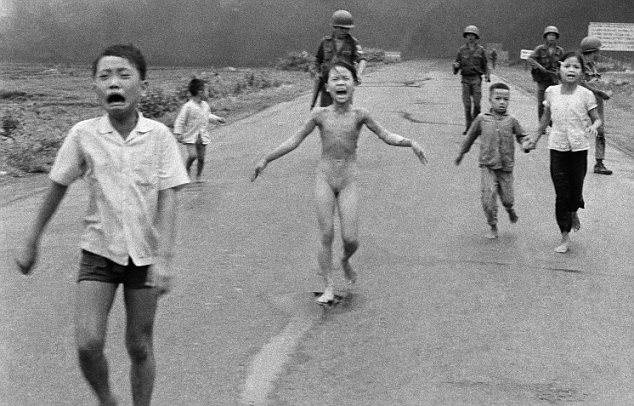
The museum attempts to portray the Vietnamese view of the war through photographs. The horrors of war have been captured vividly in the photographs. The famous photo of a naked young girl running on the street after being hit by a Napham bomb is also showcased in the museum. That image jolted people around the world. Some say it hastened the end of the Vietnam War.

Figure 42 – On June 8, 1972, AP Photographer Nick Ut captured what would become a Pulitzer Prize winning photo depicting children fleeing from Napalm bombing during the Vietnam War. In the center of the frame running towards the camera was a naked 9-year-old girl, Phan Thị Kim Phúc, also known as ‘Napalm Girl.
Many of the photographs displayed in the museum are extremely shocking as they truly reflect the atrocities that have been heaped on Vietnamese.
The museum also houses ‘India Centre’ which displays a number of photographs highlighting the cooperation between the two countries.

Figure 43 – India Gallery. Photo of Mr Ho Chi Minh flanked by President Shri Rajendra Prasad and Prime Minister Jawahar Lal Nehru – 02 Feb 1958 New Delhi

Figure 44 – India Gallery. Photo of Ho Chi Minh’s visit to Namma Bengaluru on 11 Feb 1958 – with the Governor, His Excellency Jayachamarajendra Wadiyar and artists.

Figure 45 – Notre Dame Cathedral – Saigon

Figure 46 – A local vendor selling sweet savories.

Figure 47 – Saigon Central Post office
We Visited Phnom Penh – 17 and 18 Oct 2015


There are a number of options for travelling from Siem Reap to Phnom Penh – by air, river and road. We chose to travel by road and take in a little bit more of Cambodia. We hired a SUV through the hotel and departed at 8 am with Mr Rotta the driver and his Lexus. It’s an eight hour journey – with stops in between for coffee and lunch etc.
Rotta’s English was limited and he would simply laugh away all our questions. If we persisted with our interrogation, he would ring up his wife and seek answers. He made a lot of calls J but he was very helpful and the journey was pleasant. The people by and large are extremely warm, polite, helpful and above all cheerful.

Figure 1 – A lovely round about
The country side resembles India a lot, especially Kerala. Green and lush rice fields are everywhere. Surprisingly one does not see any people on the fields. They grow a lot of rice. Rice cooked in the hollow of a bamboo stick is very popular and is called sticky rice. Poverty is visible – under fed children are employed for selling food, artifacts and souvenirs. Children are practically every where – especially near temples and market places. They are so sweet it becomes difficult to say ‘NO’ to them. The roads are reasonably ok, with very little traffic discipline. Their vans and Tempos are overcrowded and can be paralleled only by the ones we find in India. 

Figure 2 – Ssangyong from South Korea – May be 25 people in and on it.
Cows are everywhere; we almost felt at home. 
Due to very heavy rain fall from May to October, the land gets inundated with water. Consequently, almost all the houses are on stilts. Basic Cambodian architecture of sloping red tile roofs dot the country side. There are very few modern buildings and skyscrapers along the way. Village scenes resemble India in many ways. The cities are clean in parts, with patches of filth, garbage and waste lying by the road.
Hammocks are very common and one can see them hanging under trees. Even the ‘tuk tuk’ drivers carry hammocks and spread them whenever the guests depart and catch forty winks.
Tropical fruits such as pineapples, jack fruit, mangoes, oranges, rambutan, bananas, passion fruit, coconuts and water melons are very common.
Enroute, Rotta stopped at a village market to give us a ring side view and taste of Cambodian insect cuisine – fried Tarantulas, crickets, frogs, grasshoppers, silk worms and more. Deep-fried insect snack is very famous in Cambodia and it is favored due to its unique taste as well as the high-protein nutrition. These insects are meticulously mixed with some special spices and then deep fried.  In addition, Cambodians eat a lot of pork, beef and sea food. Dog meat is also popular in Cambodia. Nothing would induce me to try that particular meat!!!

Figure 3 – Rotta enjoying a fried Tarantula. A-Ping, a well-known fried spider dish in Cambodia

Figure 4– A young shopper happy to relish on a Cricket

Figure 5 – Crickets fried in red chili and onions

Figure 6 – Giant water bugs as small eats

Figure 7 – Little maggots of silk worm, deep-fried with chilies and spring onions.
By all standards their food is very tasty and reasonably priced. A good dinner – fresh vegetable and rice noodle soup, roast potatoes, veg spring rolls – their USP, deep fried calamari, stir fried chicken with chili, ginger tiger prawns and a good helping of beer costs around 37$ for four which works out to Rs 600 per head approximately.
We stopped enroute at a nice little restaurant by the river for lunch. We had a traditional Cambodian lunch.

Figure 8 – Jai taking some photos

Figure 9 – A quick back massage at the restaurant – ahhhaha 
After spending considerable time in the ‘Killing Fields’ we reached ‘Hotel Rambutan’ in Phnom Penh. Unlike in Siem Reap, this is a very clean and modern hotel. We enjoyed our stay. We retained Rotta and his Lexus as we found Phnom Penh to be too noisy, dusty and muggy for a Tuk Tuk ride. Phnom Penh is like any other capital city – over crowed, unbearable traffic, cramped for space, struggling to maintain a good façade.
The hotel had a nice little pool, Anoushka and I got in immediately to beat the heat. 17 Oct is Jai’s birthday and I was hoping the mood would cheer up after a very heart rendering visit to the ‘Killing fields’. We were the only guests by the pool and the staff went out of their way to make us comfortable. A trade mark with ‘Rambutan’. 
In no time we were reminiscing about good old days – each recalling an event or an interesting incident. The weather improved and so did the mood. A good, blended whisky or Vodka does add to the ambiance. When you travel with likeminded people – the frame of mind is very light and devoid of any stress or strain. The night, conversation and the bonding progresses naturally.
Whilst each one was busy and dreaming into the night – Anoushka went to the reception very unobtrusively and returned with a beautiful birthday cake for Jai. The rest as they is history. Extremely thoughtful of Sushama and Anoushka to have organized the cake. Big thanks to you both.

Figure 10 – A part of Hotel Rambutan

Figure 11 – Anoushka in the pool – cooling it off

Figure 12 – Anoushka and Sushama by the pool side

Figure 13 – Bonding with the birthday girl

Figure 14 – Birthday girl with all of us

Figure 15 – The creamy price one has to pay
18 Oct – Phnom Penh sightseeing 
                                                                                                                                                                                                      
The next day was spent in visiting a few important tourist attractions. Rotta in consultation with his newly married wife took us around the town in his very comfortable Lexus SUV. There is not much to see in Phnom Penh and a day is sufficient to visit a few temples, pagodas, museum and the Royal palace.
Our five day visit to Cambodia came to an end. This trip provided us with an insight into some of the oldest Asian civilizations, ancient temple 
architecture, new cuisine and much more. Cambodia has seen many ups and downs in its history. This is a remarkable nation to have weathered so many invasions, wars and genocide which wiped out one out of every four Cambodians, yet it has managed to retain its cultural identity and nationhood. There is a lot to learn from these extraordinarily resilient people, who have forgotten the abuse heaped on them and literally risen from the grave to build a legitimate and respectful life for themselves. They are very polite, courteous and helpful to others – remarkable traits.

Figure 16 – 18th morning visit – photo op

Figure 17 – A typical stupa

Figure 18 – National Museum

Figure 19 – Very well maintained with lots of artifacts

Figure 20 – A lovely folded lotus 

Figure 21 – Ganesh statue in the museum lawns

Figure 22 – A square ling – odd but common
 
Figure 23 – The Throne Hall is where the king’s confidants, generals and royal officials once carried out their duties. It is still in use today as a place for religious and royal ceremonies (such as corporations and royal weddings) as well as a meeting place for guests of the King. The present building was constructed in 1917
Figure 24 – “Moonlight Pavilion”, is an open-air pavilion that serves as stage for Khmer traditional dance in the past and present. 

Figure 25 – Another view of the Throne Hall
Figure 26 – Hor Samran Phirun “The pavilion where one sleeps peacefully.” Royal rest house and waiting area where the King waits to mount an elephant for Royal processions. Also built to house musical instruments and procession implements. Constructed in 1917. Currently housing a display of gifts from foreign heads of state

Figure 27 – Restoration work in progress. Notice the cloth façade covering the repair site – remarkable

Figure 28 –Silver pagoda – The Temple of the Emerald Buddha, but has received the common name ‘Silver Pagoda’ after the solid silver floor tiles that adorn the temple building. Unlike most pagodas, no monks live at the pagoda.

Figure 29 – A stunning model of Angkor Wat in front of the pagoda

Figure 30 – TA PROHM TEMPLE – Ruins of an old Buddha Temple.     

Headless Buddha – a priest performing a ritual


Killing Fields of Phnom Penh- Choeung Ek – 17 Oct 2015


On our way from Siem Reap to Phnom Penh, a slight deviation on the high way took us to the ‘Killing Fields’ of Phnom Penh.
Periodically, humanity has been an unfortunate witness to the darkest, most incomprehensible side of human behaviour – ‘Genocide’. Some humans have an inane ability to kill and murder their own kind without any reason, remorse or regret. Due to a combination of ill fated circumstances, Cambodia came under the rule of ‘Khmer Rouge’ the followers of the Communist party of Kampuchea led by ‘Pol Pot’ – a despotic dictator. They established their absolute control in Cambodia from 17 April1975 to 7 January 1979.
Under Pol Pot, the state controlled all aspects of a person’s life. Once in power, he began a radical experiment to create an agrarian utopia. All foreigners were thus expelled. Newspapers and television stations were shut down, radios and bicycles confiscated, and mail and telephone usage curtailed. Money was forbidden. All businesses were shut, religion banned, education halted, health care eliminated, and parental authority revoked. Thus Cambodia was sealed off from the outside world. Government made urban dwellers move to the countryside to work in ‘Collective Farms’ and on forced labour camps projects. Citizens were to be turned into traditional rural peasants, referred to as ‘Old People’. Urban workers and intelligentsia and the elite were viewed as “New People” and easily expendable.
The slightest sign of dissent meant execution by the Khmer Rouge.
The Pol Pot regime established 341 ‘Killing Fields’ all over Cambodia.  Choeung Ek’ about 17 kilometers South of Phnom Penh is one such place.17,000 people were killed in this place.Mass graves containing 8,895 bodies were discovered here after the fall of the Khmer Rouge regime. Many of the dead were former political prisoners. 
A very simple and elegant ‘Stupa’ has been erected on the site to pay homage to the departed souls. The genocide in Cambodia is unique. Out of a population of approximately 8 million, about 3 million Cambodians were systematically exterminated, starved, or worked to death during this period.
As one enters this ‘hell on earth’ you are surrounded by an eerie silence and grim faces of tourists listening to the audio commentary.An audio tour helps you go around the killing field and the running commentary totally unnerves even the hardest of humans. At the bloody end of it all you are left with a lot of questions

·         Has the human race evolved at all?
·         How can we kill our own kind?
·         Are humans so weak minded that they can follow such a despotic and deranged leader without question?
·         What was the rest of the world doing when 3 million people were being massacred?
·         Do countries only interfere when their own interests are threatened?


Pol Pot grew old and played with his grandchildren. He died in 1998 at the age of 73 without ever being brought to justice. 

The trucks carrying political prisoners would arrive in this camp and they were executed under cover of night. Chemical powder such as DDT was liberally spread on the bodies to prevent a stench. The authorities would play loud martial music and make speeches during the entire period of execution to muffle and dampen the desperate cries of the victims reaching the nearby villages. Children were held by their legs and smashed against the trunk of a ‘killing’ tree.   

Figure 1– Designed in the style of a Buddhist stupa, the Choeung Ek memorial has glass sides, and is comprised of multiple layers of human skulls.The memorial was built in 1988. Totaling 5,000 of those executed at the site, the skulls are a harsh reminder of a genocide that took place only 40 years ago. The memorial is particularly disturbing upon closer examination of the skulls, many of which bear marks of the trauma they suffered before their execution.

Figure 2 – The centre column houses over 8000 skulls, arranged at different levels based on sex and age group. These are clearly visible behind the clear glass panels of the Memorial Stupa. 

Figure 3 – The memorial has a number of boards explaining the brutality – how they were brought to the killing fields, where they stayed, how they were executed, what cunning tricks were played on the victims and so on. 

Figure 4 – Truck stop details


Figure
5 – Scores of victims were packed like sardines in small unventilated and dark sheds prior to their execution. 

Figure 6 – The filled is full of various types of graves – some for women, different graves for old people, grave with bodies without head and so on.

Figure 7 – The most chilling and barbaric act against humanity. This is tree trunk on which children’s head was banged to kill. Colorful rubber bands are pinned on to the trunk to express deep sorrow and grief. A sense of helplessness envelopes and pins you to the ground.    
We departed from the ‘Killing Field’ deeply hurt with every belief shaken from its roots. It’s impossible to believe that few fellow humans could have committed such monstrous atrocities.
The only saving grace from their gut- wrenchingly ghastly past – they have managed to retain their gentleness, courtesy and warmth towards their fellowman – Unfathomable.