

If I recall correctly, it was early seventies when Sreeni and Sukanya moved into their own house in Jayanagar, post their retirement from a government job. Prior to that Sreeni had pitched his tent in many cities across India. They now looked forward to spending their golden years in their own house and that too in ‘Namma Bengaluru”.
Allow me to deviate a bit. The organized development of Bengaluru started after the “Bubonic Plague” of 1898 devastated the old city. Several colonies with a proper sanitation system were built in Frazer Town, Chamrajpet, Basavanagudi and Malleshwaram. Subsequently, the City Improvement Trust Board or CITB (BDA now) was established in 1945. During the next twenty years it developed over 65 extensions, distributed over 60,000 sites and undertook 160 improvement schemes. Among many well laid out extensions of that period, Jayanagar was the largest extension. Unlike today, the CITB not only allotted sites, but also handed over fully built houses. The entire colony was built in a typically urban grid formation. All the houses were similar to each other in looks and dimension. Sreeni was the proud owner of just such a dwelling.
Both their children had taken the ‘Quit India’ movement very seriously and had migrated to the USA in the late sixties, albeit twenty five years after Mahatma Gandhi gave the clarion call.
Sreeni knew my father well and had kept in touch all along. After his return to Bengaluru, they renewed their acquaintance and started meeting frequently. My father noticed that Sreeni had become a bit absent minded, prone to forgetting little things, restless and at times insecure. My father narrated quite a few harmless anecdotes involving Sreeni to us.
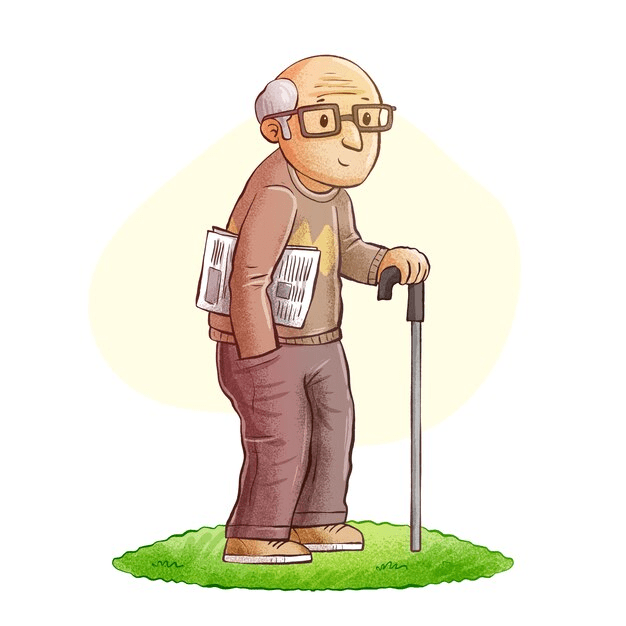
Image by pikisuperstar on Freepik
On a daily basis, after a very satisfying breakfast, Sreeni used to wander off towards the Jayanagar 4th Block market square. He would sit on a stone bench and while away his time watching the vehicular traffic and the general public. He was joined by a few friends of similar disposition. If his mood demanded it, he would buy a packet of peanuts and slowly relish it. Normally this outing was very peaceful and invigorating. However, on this fateful day, their august gathering argued very heatedly over a political issue. This acrimonious debate left Sreeni totally exhausted, irritated and disoriented. In this state of mind, Sreeni returned home.
On entering his house, he saw that his neighbour Sampath and his wife Savitri were already seated. He also sat down and exchanged the usual pleasantries with them – how are you, what a pleasant surprise, welcome home, can I get you some water, coffee etc. His neighbours were at a loss to understand the narrative which was unfolding in front of them. They were totally perplexed. Once the troubled and agitated Sreeni calmed down and things became clear, he realized his grave mistake; after the bitter argument in the market square, Sreeni had glided back in the general direction of his house and entered his neighbour’s house, thinking it was his. Blame the BDA for constructing identical looking row houses!
Due to a very serious old age-related issue, his dear wife Sukanya was advised bed rest for an extended duration. She was the ‘early to bed’ kind. On the other hand, Sreeni was a night owl. Over the years he had developed the habit of disappearing into the night for a little stroll to puff away at his favourite Charminar cigarette. This habit irritated his wife no end, especially when she was ordered bed rest. She wanted him constantly next to her. She devised an ingenious method to keep him close to her. She would tie his ‘dhoti’ (a traditional Indian man’s night dress) to the end of her sari ‘pallu’ (loose end) and make a knot. She would fall asleep holding the knot, safe in the assurance that Sreeni was still there at the other side of the knot. This creative imprisonment was totally unacceptable to Sreeni. Not to be left behind, he came up with a brilliant stratagem to outwit his immediate opponent. Whenever he felt the urge to smoke, Sreeni would quietly undo his dhoti and slip out of bed, leaving his wife holding the knot.
Sreeni and Sukanya decided to travel by train to Davanagere to attend his niece’s wedding. This involved an overnight train journey. Davanagere was known as the Manchester of Karnataka. During the 1960s, it was famous for its textile production. On the appointed day, Sreeni got ready for travel and all their belongings were neatly stored in large bag called a ‘holdall’, a must-have possession in the bygone days. It is of course, extinct today. A fore runner of Samsonite, American Tourister and Aristocrat, the holdall could literally hold all, meaning a light mattress, blanket, pillow, clothes, towel etc.
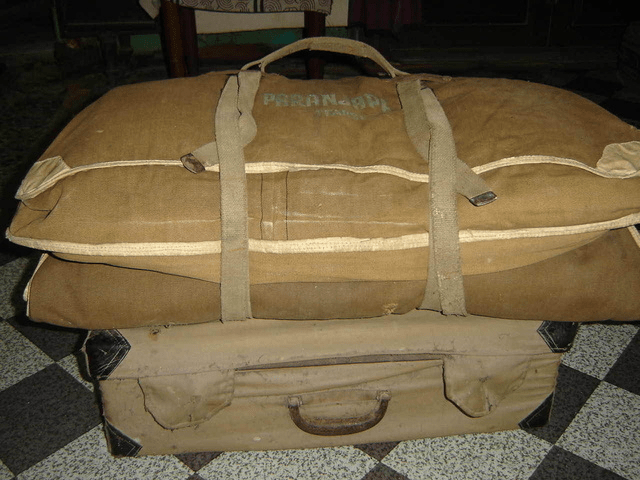
Hold All (top view)
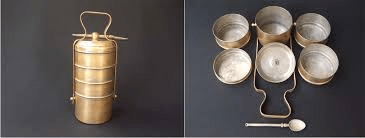
Another popular travel ‘must have’ was the ubiquitous ‘tiffin carrier’
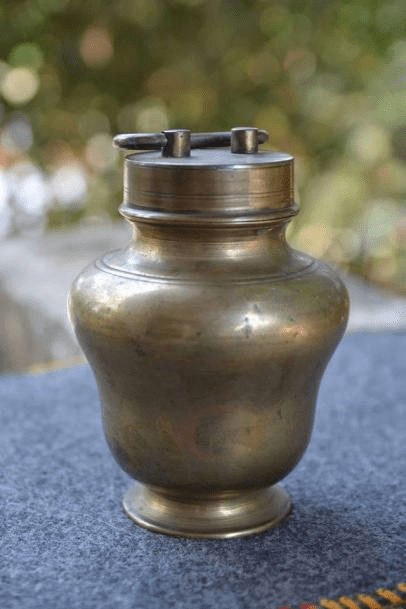
Yet another travel essential was a brass water jug called a ‘Rail chombu’ for carrying water on train journeys.
Sreeni insisted on reaching the railway station early, buying the tickets and settling down in a vacant berth long before his other fellow travellers. On entering the station, Sreeni saw an empty train on the platform. He then went about the task of settling down with military-like efficiency. They occupied two berths and spread their ‘holdall’ and slept deeply. Early the next morning, Sreeni got up from his deep slumber to find that the train had not moved an inch!
I still wonder, did good old Sreeni reach Davanagere on time.
 Captain's Corner